

You’ve seen the AI posters: the same fonts, chaotic layouts with no negative space, the neon colors, the brushstrokes. Scroll for thirty seconds and you’ll likely pass three of them.
We recently wrote about how your customers can spot AI writing. They can spot AI design even faster. The consequences for your business are very real.

You end up looking like everyone else
AI pulls from patterns. Ask it for a “clean, modern look” and it hands you the same one it hands the business three doors down. For a brand, that sameness is a problem. The whole point of investing in design is to ensure your brand expression is strategic, uniquely ownable and differentiated. Work generated from the statistical middle of everything can’t do that.
It erodes trust
Consumers can easily spot AI visuals, and plenty of them aren’t quiet about it. One post making the rounds put it bluntly:
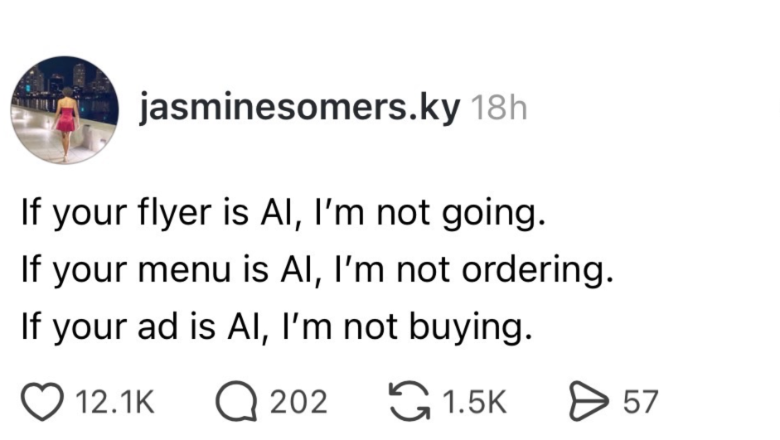
The customers who speak up are only a fraction of the ones who already scrolled past.
There’s nothing inherently wrong with using AI in your workflow. But obvious AI artwork can signal that a brand chose speed over quality. That perception matters when you’re trying to build credibility or position your business as premium.
It doesn’t understand context
Good design solves a communication problem. A designer considers numerous factors: the objective, brand guidelines, audience, tone & voice, viewing distance, accessibility, print requirements — just to name a few. Those strategic decisions shape everything from font size to contrast to visual hierarchy. AI has no understanding of those objectives. It simply predicts pixels based on statistical patterns, not human intent.
Proving its human-made is the new marketing flex
Here’s how far the trust problem has moved. A year ago, a behind-the-scenes video was a fun extra. Today it’s a defense.
LEGO’s World Cup campaign put Messi, Ronaldo, Mbappé, and Vinícius Jr. around one table, exactly the kind of impossible celebrity lineup audiences have learned to distrust. So LEGO tagged the posts #HonestlyNotAI, telling viewers what to think before they had a chance to wonder. When Apple’s “Hello, MacBook Neo” film launched, the company followed it with a behind-the-scenes short showing the stop-motion fireworks, confetti cannons, and hand-built rigs that made it.
Others have turned the pledge itself into the campaign. Aerie extended its no-retouching promise to ban AI-generated images of people entirely, followed by a Pamela Anderson spot built on the line “you can’t prompt realness.”
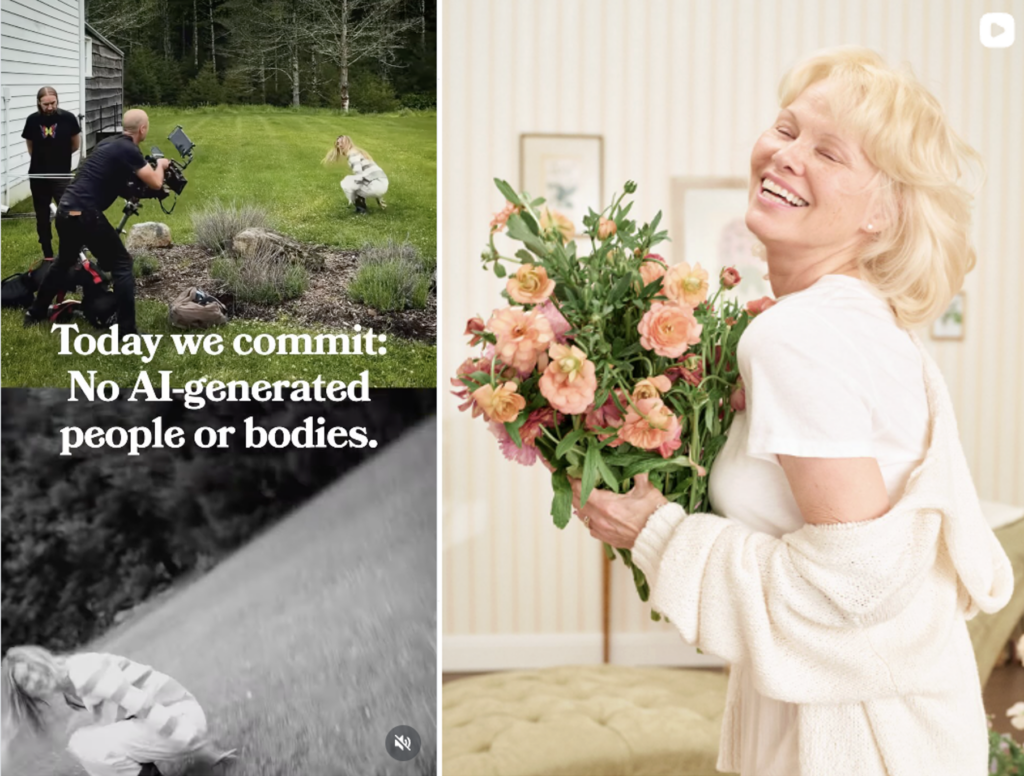
Then there’s the cautionary side. Netflix recently faced backlash after disclosing it had used generative AI across roughly 300 productions this year. Audiences rejected that a media giant was cutting creative corners. When consumers feel a brand is taking shortcuts, the loss of trust outweighs the time saved.
Let AI support the process, not replace it
None of this means AI has no place in the creative process. It’s useful for brainstorming concepts, exploring directions, and building rough mockups. Many designers already use it to speed up parts of their workflow. The difference is that AI supports the process instead of replacing it.
Your brand is one of your most valuable assets. Every poster, ad, and social graphic either reinforces that identity or chips away at it. The brands people remember don’t look like everyone else. They communicate with intention, consistency, and a point of view.
Those qualities still come from human creativity.
Building a brand that looks and reads unmistakably like you is what we do at Tell Your Story. Get in touch and let’s talk.
