

Marketing teams are feeling the pressure. Too many channels, not enough time, and a content calendar that feels like a treadmill they can’t get off.
The instinct is usually: we need to create more.
Rather, you just need to do more with the content you already have.
If every platform — LinkedIn, Instagram, your blog, and trade media — is treated as a separate content engine that requires a completely fresh idea from scratch, you’re working harder than you need to.
Most teams spend a lot of time creating strong flagship content. A report gets written, a keynote gets polished, or a long article goes live. Then it gets shared once or twice and fades out.
Content atomization changes that pattern. It turns one strong asset into a system of connected content that reaches different audiences in different places.
What is Content Atomization?
Content atomization is the practice of taking one high-value piece of content — like a whitepaper, webinar, keynote speech, or research report — and breaking it down into multiple, highly optimized smaller assets tailored for different channels and audiences. The stronger the original asset, the more material you can pull from it.
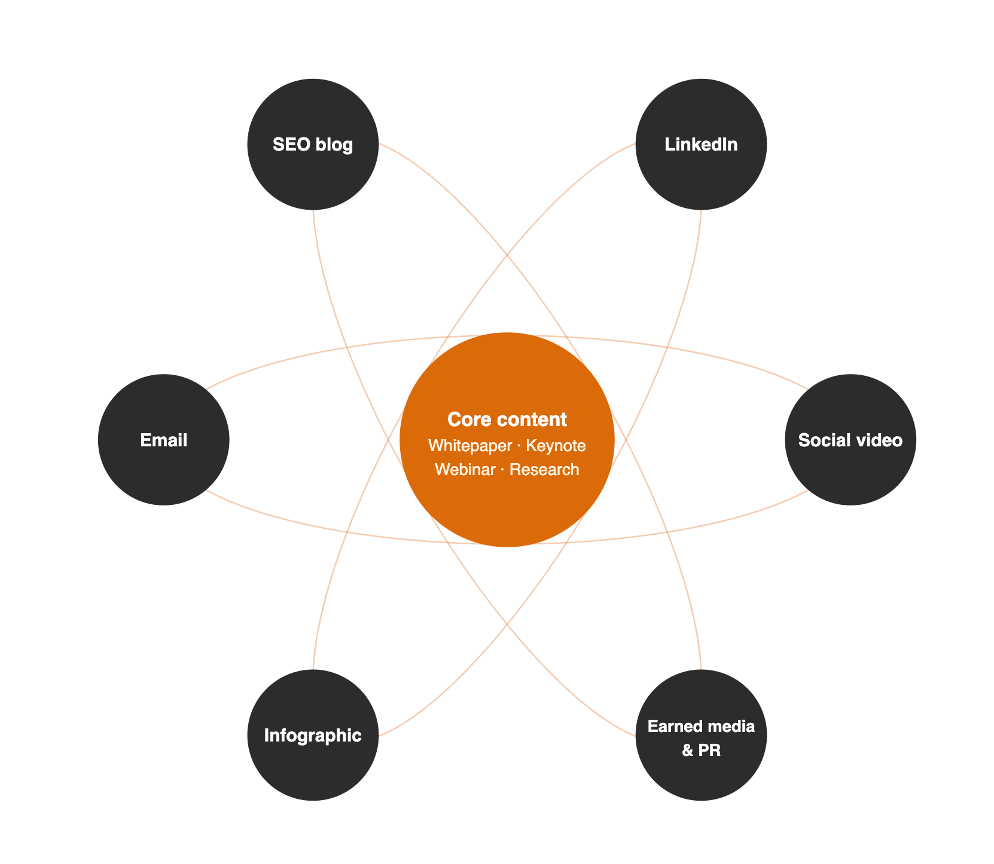
How Content Atomization Works
Say your company published its major annual industry report. Most brands drop the PDF on a landing page, fire off a couple of social media posts, and move on. Here’s what a content atomization strategy looks like instead:
- For LinkedIn: Pull 3–5 most surprising statistics and design them into a clean, swipeable image carousel.
- For Your Website: Take one specific subsection of the report and expand on the nuances to create a highly readable, SEO-optimized blog post.
- For Social Video: Take a recorded clip of your CEO or product expert discussing the top finding and format it into a vertical video for YouTube Shorts or Instagram Reels.
- For Email: Build a newsletter or nurture sequence around the key themes.
- For Earned Media & PR: Package the data points into a press release and pitch specific, exclusive angles to trade media outlets to secure industry coverage.
- For Pinterest & Visual Engines: Map out the key trends from the data and transform them into a high-utility, shareable infographic.
From one deep-dive project, you’ve now unlocked weeks, or months, of platform-native marketing assets.
Why This Approach Works
Audiences don’t consume content in one place or in one format. Some want a quick stat on LinkedIn. Others want a deeper read. Others only engage through video or news coverage. Atomization meets people where they already are.
It also improves consistency. One core message gets reinforced across multiple channels without requiring new ideas every time. They might catch your LinkedIn carousel on a Tuesday morning, see your CEO clip on YouTube two weeks later, and read the trade coverage your PR team secured from the same campaign.
For resource-strapped teams, the ROI is straightforward: the hard work is already done. Atomization just makes sure it actually reaches people.
Where to Start
The biggest mindset shift is treating distribution as part of the creative process, not an afterthought.
- Start by auditing your last three major content pieces. What did you create from them? What could you have created?
- Build atomization into your editorial planning from the start. Before a report goes into production or a webinar gets written, map out what it could become across channels. Planning upstream saves time and produces better assets.
- Align your PR, social, and content teams early. The strongest atomization strategies happen when teams are in sync from day one, not playing catch-up after the fact.
Give Your Content the Lifespan It Deserves
The brands winning in B2B content right now aren’t necessarily publishing more. They’re extracting more value from what they already have.
Find your strongest asset. Break it down. Put it in front of the right audiences in the right formats — and let one great idea do the work of ten.
Ready to build a content atomization strategy for your brand? Let’s talk.